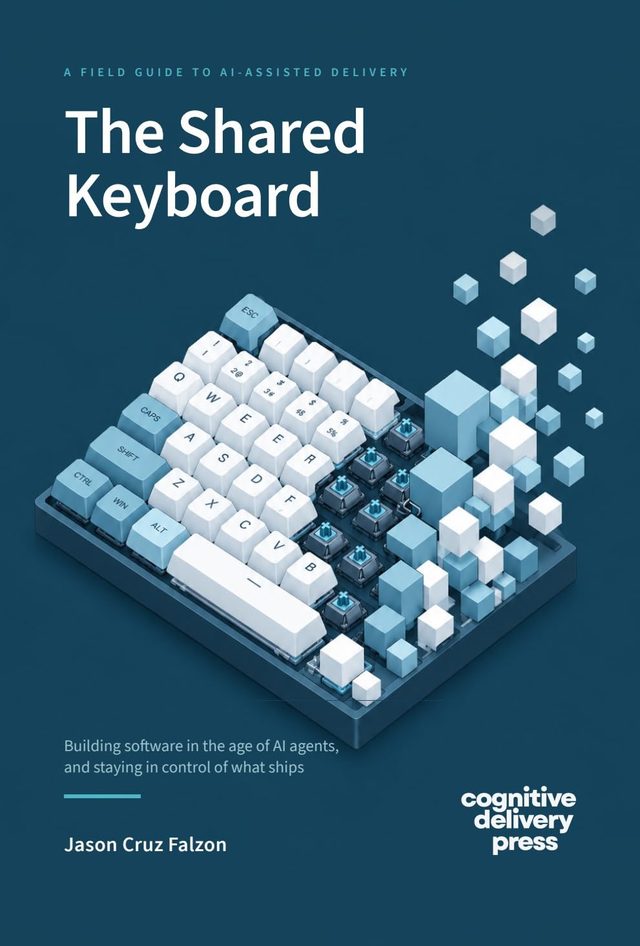
The Shared Keyboard
Building software in the age of AI agents, and staying in control of what ships
A field guide to AI-assisted delivery · 131 pages · Cognitive Delivery Press
Out now on Kindle, and included in Kindle Unlimited
The agents are already in your codebase
Most teams have stopped debating whether to let AI write their software. It is already happening, one pull request at a time, on teams that would never call themselves experimental. A developer describes a change, an agent drafts it, a colleague approves it, and by the afternoon it is in production. No pilot, no steering group. Just a normal Tuesday.
What far fewer teams have worked out is how to stay in control of it. The book begins where the honest conversations begin, with what the research says once you take the headline numbers off the slide. The benchmark everyone quotes measures a narrower task than the job you need done. A controlled trial found developers running 19 per cent slower with AI while believing they were 20 per cent faster.
The pattern underneath all of it is the same. The bottleneck is not the model. It is the system the model sits inside. That system is the part you can change, and this book is about how.
The Cognitive Delivery Framework: a redesign of the software lifecycle for a keyboard with more than one set of hands on it. And the Cognitive Delivery Index: a way to tell governance that works from governance that is merely written down.
The people who now carry the work
Your name on the diff
What changes when your name goes on a diff an agent drafted, and how to review for the mistakes these tools really make.
Helping or quietly costing you
How to tell whether your AI adoption is helping or quietly costing you, and how to govern it without turning governance into theatre.
What you are answerable for
What you are answerable for now, and what real assurance looks like when agents are in the loop.
Story-led, with a framework underneath
Not a book of predictions or hype. A practical field guide, drawn from patterns across many teams, and it ends where it should, with what to do on Monday. Not a transformation programme. One team, one honest quarter, one place to put your hands first.
The altitude problem
Why the methods feel awkward side by side, and the four layers that resolve it.
Measuring the real thing
The six dimensions, the five levels, and the governance theatre gap at the centre.
Building the controls
What it takes to make a control change behaviour, told through the plugin’s own rebuild.
One rule at the close of every chapter
A control you have never seen change a decision is not a control. It is a record of intent.
If you cannot show the prompt that produced the code, you do not have provenance. You have a filing cabinet.
Mandate substance, not method. Coherence in principles survives a reorg. Method conformance does not.
The full set lands as an appendix: one rule distilled from each chapter’s argument.